Understanding the intended meaning is important because a single abbreviation can convey completely different ideas in different situations.
In casual conversations, ASL often relates to personal information, while in professional or academic environments, it may refer to something entirely different.
If you spend time chatting online, using social media, or messaging new people, you may have come across the abbreviation ASL. Many people search for ASL meaning in text because the acronym can have different meanings depending on the context in which it is used.
While it is most commonly associated with online chats and messaging platforms, ASL can also represent terms in education, healthcare, aviation, and other specialized fields.
Meaning & Definition
The abbreviation ASL has multiple definitions, but the most common meaning in online text conversations is:
Age, Sex, Location
This phrase became popular in internet chat rooms where users wanted to quickly learn basic information about the person they were talking to. Instead of typing three separate questions, people simply wrote “ASL?”
For example:
- Person A: Hi!
- Person B: ASL?
- Person A: 24, Male, Lahore.
In this example, Person B is asking for the other person’s age, gender, and location.
However, ASL can also stand for:
- American Sign Language
- Advanced Squad Leader
- Above Sea Level
- Age/Sex/Location
- Application Services Library
- Aviation and technical terms depending on the industry
Because of these multiple meanings, context plays a major role in determining what ASL means in a specific conversation.
What Does ASL Mean on Instagram
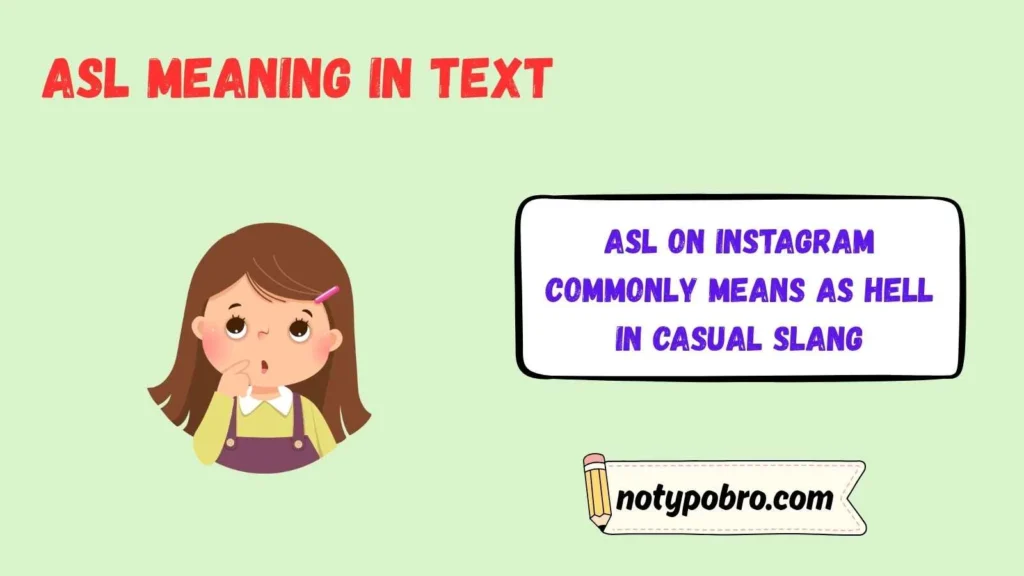
- ASL on Instagram commonly means As Hell in casual slang.
- It is often used to add strong emphasis to a statement.
- People may write tired asl to mean extremely tired.
- Funny asl can mean extremely funny in a casual way.
- The meaning usually depends on the words around ASL.
- Instagram users often use ASL in comments and direct messages.
- It is mainly found in informal conversations.
- ASL can make a reaction sound stronger or more emotional.
- Some users type ASL in lowercase as asl.
- The slang meaning is common among younger internet users.
- ASL may also have other meanings outside social media slang.
- Context is important before deciding what ASL means.
- ASL is generally not suitable for formal or professional messages.
- On Instagram, ASL usually adds emphasis rather than changing the main meaning.
Background
The popularity of ASL dates back to the early days of the internet. During the late 1990s and early 2000s, online chat rooms, instant messaging services, and forums became extremely popular.
At that time, users often interacted with strangers. Since typing was slower and internet connections were limited, abbreviations became common. ASL emerged as a quick way to gather basic information about someone before continuing a conversation.
The abbreviation became especially common on:
- Chat rooms
- Instant messengers
- Online gaming communities
- Discussion forums
- Early social networking platforms
Over time, the internet evolved, and users began sharing profile information directly on social platforms. Although ASL is not as dominant as it once was, it remains widely recognized and still appears in modern conversations.
Today, younger users may encounter ASL through memes, online communities, dating apps, or conversations with people familiar with internet culture.
Funny ASL Meaning
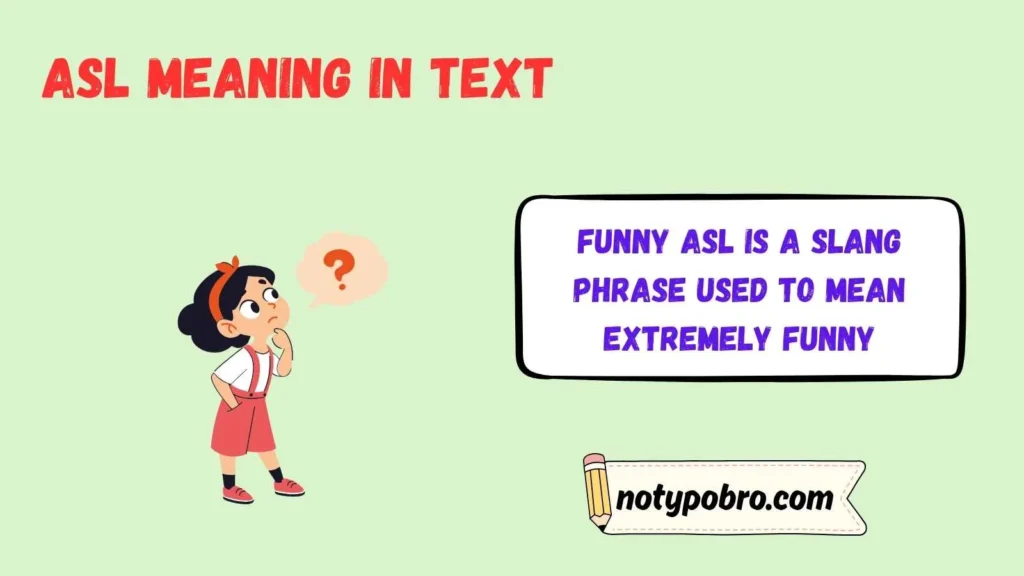
- Funny asl is a slang phrase used to mean extremely funny.
- The ASL part is commonly used as an intensifier.
- Someone may say that after seeing a hilarious video or meme.
- It is usually meant as a casual and enthusiastic reaction.
- Funny asl is common in texting and social media conversations.
- The phrase can show that something made someone laugh a lot.
- Friends often use it when reacting to jokes or funny situations.
- It can also appear in Instagram comments and captions.
- The phrase is informal and conversational.
- It may sometimes include profanity depending on the original slang expansion.
- The exact tone depends on the conversation.
- Funny asl is usually positive when reacting to entertaining content.
- It should generally be avoided in formal communication.
- Similar phrases include really funny, extremely funny, and hilarious.
Usage in Different Contexts
The meaning of ASL changes significantly depending on where it is used.
Casual Online Communication
In everyday chats, ASL usually means:
Age, Sex, Location
Example:
- “Hey, ASL?”
The sender wants basic information about the person they’re talking to.
Educational Context
ASL may refer to:
American Sign Language
Example:
- “I’m learning ASL this semester.”
In this case, the person is referring to the sign language used by many deaf and hearing individuals.
Geographic Context
ASL can mean:
Above Sea Level
Example:
- “The village is 1,500 meters ASL.”
This indicates elevation relative to sea level.
Technology and Business
In certain organizations, ASL may represent internal systems, software libraries, or technical terminology.
Aviation and Engineering
Some industries use ASL as a measurement or technical abbreviation related to altitude and geographic positioning.
Because ASL has many meanings, understanding the surrounding conversation is essential.
What Does ASL Mean on Snapchat
- ASL on Snapchat can have different meanings depending on context.
- In modern slang, ASL often works as an intensifier meaning extremely.
- Snapchat users may use it in casual messages with friends.
- A phrase such as tired asl means extremely tired.
- Funny asl means extremely funny in slang usage.
- ASL can appear in chats, snaps, captions, or replies.
- The lowercase form asl is also common online.
- Older internet usage may give ASL a completely different meaning.
- ASL historically stood for age, sex, location in online chat.
- That older meaning was especially common in early internet conversations.
- Snapchat context can help determine which meaning is intended.
- ASL is usually informal when used as modern slang.
- It is best to consider the surrounding message before interpreting it.
- If the meaning is unclear, asking the sender can avoid confusion.
Meaning in Chat, WhatsApp, Instagram, TikTok
Social media users frequently encounter ASL in direct messages, comments, and online communities.
On WhatsApp
When someone sends “ASL?” on WhatsApp, they are usually asking:
- How old are you?
- What is your gender?
- Where are you from?
Example:
- “Hi there, ASL?”
On Instagram
Instagram users may use ASL in direct messages when starting a conversation with someone they do not know well.
Example:
- “ASL? You seem interesting.”
On TikTok
TikTok comments and live chats occasionally include ASL as a quick way to ask about a creator or viewer.
Example:
- “ASL everyone?”
In Gaming Chats
Gamers sometimes use ASL when meeting new teammates online.
Example:
- “ASL before we start?”
Although it remains recognizable, many modern users now ask these questions directly rather than using the abbreviation.
ASL Meaning TikTok
- On TikTok, ASL is commonly used as casual internet slang.
- It can function as an intensifier meaning extremely.
- Users may write cute asl to emphasize how cute something looks.
- Funny asl can emphasize that a video or comment is very funny.
- TikTok comments often use short slang expressions like ASL.
- The term can make reactions sound more dramatic or enthusiastic.
- ASL may appear in captions, comments, replies, and messages.
- The lowercase form asl is frequently used in casual typing.
- Its meaning depends strongly on the sentence.
- ASL is generally associated with informal online communication.
- TikTok users may combine ASL with other internet slang.
- It is not normally used in formal or academic writing.
- Older meanings of ASL can still appear in some conversations.
- Checking the context is the easiest way to understand ASL correctly.
Meaning in Physics, Medical, and Aircraft Terminology
ASL is not limited to texting and social media.
Physics and Geography
In scientific discussions, ASL often means:
Above Sea Level
This measurement indicates how high a location is relative to average sea level.
Example:
- “The research station sits 2,000 meters ASL.”
Medical Field
In healthcare settings, ASL commonly refers to:
American Sign Language
Medical professionals may use this term when discussing communication support for deaf patients.
Example:
- “The patient requested an ASL interpreter.”
Aircraft and Aviation
In aviation, ASL frequently means:
Above Sea Level
Pilots and aviation personnel use altitude references measured relative to sea level.
Example:
- “The aircraft reached 10,000 feet ASL.”
Because aviation relies heavily on accurate altitude measurements, understanding this meaning is especially important in technical environments.
What Does ASL Mean in Sign Language
- ASL in sign language usually stands for American Sign Language.
- American Sign Language is a complete natural language.
- It is widely used by Deaf and hearing communities in the United States.
- ASL has its own grammar and sentence structure.
- It is not simply spoken English converted into hand movements.
- ASL uses hand shapes, movements, facial expressions, and body positioning.
- Different signs can communicate different words and concepts.
- Facial expressions can also play an important grammatical role.
- ASL is a visual language rather than a spoken language.
- It has developed within Deaf communities over many generations.
- ASL is different from British Sign Language.
- ASL should not be confused with internet slang meanings.
- The surrounding context determines whether ASL refers to the language or slang.
- When discussing communication or Deaf culture, ASL usually means American Sign Language.
Common Misconceptions
Several misunderstandings surround ASL.
Misconception 1: ASL Has Only One Meaning
Many people assume ASL always means Age, Sex, Location.
Reality: It can also mean American Sign Language or Above Sea Level.
Misconception 2: ASL Is a New Internet Term
Reality: The abbreviation has existed since the early days of online chat rooms.
Misconception 3: ASL Is Used Everywhere Equally
Reality: Its popularity varies by age group, platform, and region.
Misconception 4: ASL Is Always Appropriate
Reality: Some people may find personal questions about age, gender, or location intrusive, especially when talking to strangers.
What Does ASL Mean in Medical Terms
- ASL can have several meanings in medical and healthcare contexts.
- One medical meaning is arterial spin labeling.
- Arterial spin labeling is an MRI technique used to evaluate blood flow.
- It can provide information about tissue perfusion without requiring a traditional contrast agent.
- ASL may also represent other medical terms depending on the specialty.
- Medical abbreviations are often specific to a particular department or field.
- The meaning can differ between radiology, laboratory medicine, and clinical practice.
- Healthcare professionals usually rely on the surrounding medical information.
- ASL in a medical report should not automatically be interpreted as internet slang.
- The full term may be explained elsewhere in a report or medical document.
- Patients should consider the specific context of the abbreviation.
- Medical abbreviations can sometimes have multiple interpretations.
- A healthcare professional can provide the most accurate meaning for a specific report.
- The medical meaning of ASL is completely different from its social media slang uses.
Similar Terms & Alternatives
Several alternatives serve similar purposes in online conversations.
Alternatives to ASL
- Tell me about yourself
- Where are you from?
- How old are you?
- What’s your background?
- Can I know a little about you?
Similar Internet Abbreviations
- BRB – Be Right Back
- IMO – In My Opinion
- IDK – I Don’t Know
- TBH – To Be Honest
- DM – Direct Message
- FYI – For Your Information
These abbreviations help users communicate quickly in digital environments.
What Is Your ASL Meaning
- What is your ASL is an older internet chat expression.
- In older online conversations, ASL commonly meant age, sex, location.
- People used it to ask basic personal information from someone online.
- Age referred to how old the person was.
- Sex traditionally referred to the person’s sex or gender in those chats.
- Location asked where the person lived or was located.
- The phrase became popular in early chat rooms and messaging communities.
- It was often used when strangers first started talking online.
- Modern users may recognize ASL differently because internet slang has changed.
- On newer social platforms, ASL can have other meanings.
- Context is especially important when interpreting this older expression.
- The phrase may sound outdated to many modern internet users.
- It is generally more associated with early online chat culture than current slang.
- If someone asks ASL today, the intended meaning depends on the platform and conversation.
How to Respond to ASL
Your response depends on your comfort level.
If You Want to Answer
Example:
- “22, Female, Karachi.”
If You Prefer Limited Information
Example:
- “I’m in my twenties and from Pakistan.”
If You Don’t Want to Share Personal Details
Example:
- “I’d rather not share personal information right now.”
If You Need Clarification
Example:
- “Do you mean Age, Sex, Location or something else?”
Being cautious when speaking with strangers online is always a good idea.
What Does ASL Abbreviation Mean
- ASL can represent several different phrases and terms.
- In social media slang, ASL can mean as hell when used for emphasis.
- In American sign language discussions, ASL means American Sign Language.
- In older internet chat, ASL commonly meant age, sex, location.
- In medicine, ASL can refer to arterial spin labeling.
- The correct meaning depends on the context.
- Social media platforms often use ASL as casual slang.
- Educational or linguistic discussions may use ASL for American Sign Language.
- Older chat conversations may use the age, sex, location meaning.
- Medical documents can use ASL as a specialized clinical abbreviation.
- The same abbreviation can therefore have completely different meanings.
- Looking at the surrounding words is the easiest way to identify the intended meaning.
- ASL should not be interpreted automatically without considering the context.
- Understanding the platform and topic can quickly reveal which ASL meaning is intended.
Differences from Similar Words
| Term | Meaning |
|---|---|
| ASL | Age, Sex, Location or other context-specific meanings |
| DM | Direct Message |
| TBH | To Be Honest |
| IRL | In Real Life |
| IMO | In My Opinion |
| FYI | For Your Information |
Unlike many internet abbreviations that have a single meaning, ASL can represent multiple concepts depending on context.
This flexibility is what often causes confusion among new internet users.
Relevance in Online Conversations & Dating Apps
ASL continues to appear in online communities and dating environments.
Online Conversations
People use ASL to quickly learn basic information before engaging in a longer discussion.
Dating Apps
Some users ask ASL to determine:
- Age compatibility
- General location
- Basic demographics
However, many modern dating platforms already display this information in user profiles. As a result, ASL is less common than it once was.
Safety Considerations
When using dating apps or chatting with strangers:
- Avoid sharing sensitive information too quickly.
- Protect your privacy.
- Verify identities before sharing personal details.
- Be cautious with location-related information.
ASL remains part of internet culture, but privacy awareness has changed how people use it today.
FAQs:
What does ASL mean in text messages?
In most text conversations, ASL means Age, Sex, Location.
What does ASL mean on social media?
It commonly means Age, Sex, Location, although context may change the meaning.
Is ASL still used today?
Yes, but it is less common than during the early internet era.
What does ASL mean in education?
It often refers to American Sign Language.
What does ASL mean in aviation?
In aviation, ASL usually means Above Sea Level.
Is ASL considered rude?
Not necessarily, but some people may feel uncomfortable sharing personal information with strangers.
How should I reply to ASL?
You can answer directly, provide limited details, decline politely, or ask for clarification.
Can ASL have multiple meanings?
Yes. Common meanings include Age, Sex, Location; American Sign Language; and Above Sea Level.
Why do people ask ASL online?
They typically want basic information before continuing a conversation.
Is ASL commonly used on dating apps?
Sometimes, but many dating platforms already display the information users seek.
Conclusion:
Understanding ASL meaning in text is important because the abbreviation can represent several different concepts depending on the situation. In online chats and messaging platforms, it most commonly stands for Age, Sex, Location, a phrase that origina
ted during the early days of internet communication. However, ASL can also refer to American Sign Language in educational and medical settings or Above Sea Level in scientific and aviation contexts.
The key to interpreting ASL correctly is paying attention to the surrounding conversation. Whether you encounter it in a text message, social media comment, dating app, classroom, healthcare discussion, or technical document, context will reveal its intended meaning.
By understanding these various uses, you can communicate more confidently and avoid misunderstandings when interacting online or in professional environments.

I am Naqash Ayub, the content creator behind NoTypoBro, where I simplify the meanings of text abbreviations, internet slang, and social media terms. My goal is to provide accurate, easy-to-understand, and reliable explanations that help readers stay updated with modern digital communication.